Sunday, February 6, 2022
Case study
Thursday, February 3, 2022
Production, distribution, exhibition
Production, distribution,
and exhibition
Production:
- When researching about the production aspect of films I have found that this refers to the making of these films; finding the idea, writing the script, pitching it to a studio, setting a budget, casting stars and employing a crew, filming, and editing.
- In addition to the setting a budget component, production needs its investors in order to get this necessary funding. The global cinema industry box office is a successful company and so these investors try to reduce the risk of losing money by difficult decisions. 90% of these box office takings come from the "big six" these six majors consist of: Paramount pictures, Universal, 20th Centaury fox, Warner bros. pictures, Walt Disney, and Columbia pictures. Some movie studies the create the best horror movies are Blumhouse, platinum dumes, ghost house pictures, Lionsgate films. But a ideal production company that I would do to produce my own film is Blumhouse.
- When making a production, there is a few potential risks that lead to questions; What level of audience will it attract?, Level of funding necessary?, Is it marketable?, Will the funding make a profitable return?. These questions are needed because if the answer is no to any of these then changes will be made to the details of the film to make sure its a yes but apart from that these investors will take their money somewhere else.
- After the investors make the funding available(greenlit) the director can then start filming.
- When doing the production portion it is important set budgets for example the horror film Scream, just for production the budget is $31,085,973. But for the most profitable film "Paranormal activity", against its poultry budget of $15,000 it earned $193 million.
Distribution:
- When making a advertising plan, the film distributor must decide how it will present a film to a directed audience. Once they do that they can look for the unique selling point or the unique selling proposition(USP) to see what aspects of their products are better than competitors.
- After they look at the main components of the film and taking them into consideration, then they have to decide what elements to stress in the market place to figure out how they want to put their product onto the market.
- Some ways to market films: poster, trailers, online and mobile content, special screenings/ premieres, interviews/articles, merchandise.
Exhibition:
- Film exhibition is the last stage to the films expedition from the idea to the audience.
- Once the cinema is released, the film will be available on different platforms
Thursday, January 27, 2022
Horror Films Research
Horror film research
Horror film components
Visual elements: From my research on horror films, some common visual elements in mise-en-scene; settings that are in a cabin or forest at night used to gain a tense fearsome atmosphere and dark areas used to help with jump scares. Props that consist of weapons like chainsaw, knifes, spiritual artifacts, and crosses/bibles. The dark lighting such as low-key lighting used to conceal whoever is hiding in the dark and it helps to create shadows. The color's used such as red can be used to signify a lot of blood is being used, also the usage of black can portray evil nature or lost soul and white could mean that the character is good and pure. In cinematography birds eye view, close up, tracking or panning, tilted angle, low angle, handheld camera shots. In editing match cuts, jump cuts, parallel editing, fade in/out, cross cut.
Auditory elements: In horror films some sounds commonly used are instruments, breathing, footsteps, ghosts, stabbings,
Characters: In horror films, the common protagonist and antagonist consist of the non believer, hero, hysterical character, villain(killer, slasher, clown, masked characters)
Representation: Common representations in horror films are a chain of unfortunate train of events
Wednesday, November 17, 2021
Editors Review
Editing Software Review
For my editing software review, three video editing software's that I've researched is openshot.org; clipchamp.com; vimeo.com because they meet at least one requirements.
Compare and Contrast
Minimum Requirements:
Evaluation:
Friday, October 29, 2021
Research on film openings
Research on Film Openings
- The key elements / features of a film opening sequence are establishing setting, mise-en-scene, character placement, representing genre and cinematography. An establishing setting is a features used to draw the audience in and to give them an insight into where the film is going to be set, this can be done with an establishing shot. Mise-en-scene is basically everything that is captured in the frame used for representing emotion and setting the mood. During the scene the character placement has a huge importance because it represents different status and class or perhaps the relationships between the people in the film. Without the film directors revealing too much of the genre, the genre can be represented by the genres conventions that can be used suggest the narrative and story line and give us an insight for what is to come further into the film. So that as we "the audience" can decide what type of movie we choose to watch, and if the opening doesn’t give us that, we zone out or choose to stop watching. Lastly, cinematography which is the way the footage is presented, this is the key factor that is visually important because it makes it aesthetically pleasing as the audience will become induced into the film because it meets our needs.
- The purposes and reasons for film openings are to set a powerful expression of motion graphics that are used to prelude to the movie. They engage the audience by hinting at what is about to start, whether it’s a movie, TV show, or Web animation. The functions of a title sequence is to set the tone of the movie you are about to see. The effectiveness of theses title sequences are to engage and excite the audience by hinting at some of the topics, themes, and, in some cases, the challenges that characters will be facing. The intention is to build anticipation, sometimes revealing some of the main character’s traits and possibly setting the stage for questions that will be answered later in the movie.
- The similarities in the opening scenes (conventions) irrespective of the genre
Compare / contrast conventions by genre
Visual elements: Common settings in dramas, horror, and comedy films are haunted house/abandon places that are dark, horror films use lowkey/dim lighting while dramas us side lighting. In drama, comedy, and horror film opening scenes, they use medium shots, close up shots, establishing shots, long shots
Auditory elements: In dramas and in comedy's, there is voice overs unlike in horror where there's just dialogue and music
Character development: In drama and horror films some character types the have in common are the protagonists, the antagonist
Plot introduction: In drama and in horror movies, the plot is usually introduced with flash backs and flash forwards but in comedy's, they mostly us teasers.
Representation: In drama films and in horror films a obvious stereotype in the opening scenes are an unfortunate train of events.
top 3 favorite film opening
Top 3 Favorite Film Openings
Eli(2019)
- The horror film Eli is about a boy that becomes trapped in a haunted house while undergoing a rare disease that are treated by mysterious doctors. But Eli's mother used the disease to cover the reality of him being the son of lucifer/Satan.
- Opening Scene time stamp:(0:50-2:25)
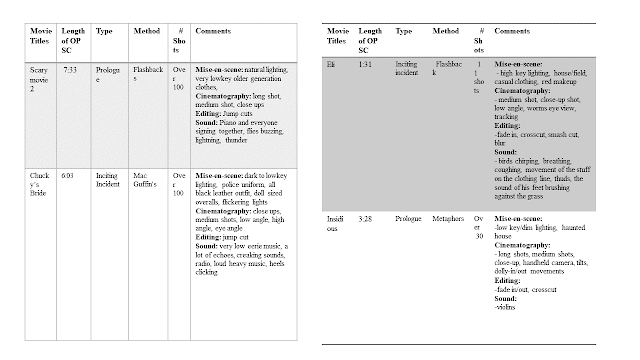
- The opening scene of Eli starts off with the opening credits screen to a black screen in which it shows a tree outside, the camera is tilting downward as it fades into the glass of the backdoor that Eli is walking up to. Once Eli removes his hand from the glass, the camera dolly's in getting a closer shot of the hand print and it fades into the next scene where he's standing on the grass. The camera tilts upward into a medium shot showing Eli breathing and running in the grass. The camera then goes into a low shot tilting back up, as the camera is tracking him as he's running. When he goes onto the ground, there's a cross cut which showed his point of view but blurred and then it went back to him coughing. The camera move to a medium to a close up shot as his face got red and he started yelling. As he starts yelling louder, it smash cuts into him waking up from a dream. This opening scene connects to the overall theme of the plot by basically showing a prologue scene without the voiceover which is like a flashback scene that reveals a pivotal moment. The purpose of this opening scene is to show the past before the events of the film.
5 feet Apart
- The romance/drama five feet apart is about a seventeen year old girl who spent most of her life in the hospital due to her having cystic fibrosis. During some of that time she meets a boy with same illness, but though restrictions dictate that they must maintain a safe distance from each other.
- Opening scene time stamp:(0:34-1:33)
- The opening scene of five feet apart opens with clips of various people living their lives and a voiceover of Stella (Haley Lu Richardson) talking about the importance of human touch. She talks about how you don’t realize how important touch is until you cannot have it. It connects to the overall plot of the story because in her voiceover it basically pertains to the fact that she has a disease were her and her boyfriend have to stay five feet apart and cant touch each other. The purpose of this film opening is to give a prologue montage with voiceover and/or a character opening tat is used to set up the main characters.
Insidious
- The horror film Insidious is about these parents named Patrick Wilson and Rose Byrne who take drastic measures when it seems their new home is haunted and their comatose son is possessed by a malevolent entity.
- Opening Scene time stamp:(0:50-4:38)
- The opening scene of Insidious starts off with the camera tilting downward to this light in which the opening credits start to appear and the camera starts turning in a circle like a arc shot. Then the camera tilts downward, in a long shot and the handheld camera is going toward the left creating suspense. As the handheld camera moves around the house, it dolly-ins into the malevolent entity and then it fades out into a black screen. Once it fades back in, it shows the title, it cross cuts different parts of the house and in between those shots it goes black. Once it fades out from the clock, it fades back into a shot where the mother is laying down and the color changes from black and white as the camera dolly's out. This opening scene connects to the overall theme of the plot by showing certain aspects that have a huge importance to the theme of the film . The purpose of this opening scene is to show what the film will mainly be focusing on like the entity, the haunted house, the mother, and the son who gets possessed.
Comparison/contrast of the films
Visual elements: In Eli, five feet apart, and insidious the cinematography used are long shots, medium shots, and close-up. Since Eli and insidious are both horror films, they use lowkey/dim lighting, haunted houses, cross cut, jump cuts, match cut, fade in/out, tilting, and handheld camera. But unlike those films five feet of part is more so using high key/ natural lighting and the setting is at a hospital.
Auditory elements: Five feet apart uses voice overs and dialogue. Eli doesn't use voiceovers but it uses more so background noises like birds chirping, breathing, coughing, movement of the stuff on the clothing line, thuds, the sound of his feet brushing against the grass. In insidious, there was a use of violins.
Character: In insidious, the roles likely to be important is the son, the mom, and the entity which are showed in the opening scene. In Eli, the roles likely to be important is the main character Eli. But, unlike the other two moves, five feet apart showed multiple people but the only person that had real importance was the boy at the end and herself.
Representation: In Eli and five feet apart the obvious stereotypes are when the main characters have some disease where their basically allergic to everything and they have to have certain rules and boundaries due to their sickness. In insidious the representation is when the family try's to get evil spirits away from their child by calling someone to help do a exorcism.
Wednesday, October 6, 2021
Types of Movies / Movie Genre
Types of Movies/ Movie Genre Introduction
There are many types of movies and within these different types of movies they are classified in these certain types of genres. A genre is a style or category of art, music, literature or film. When thinking about a genre, think abut the different parts of the film, these different components help the audience to identify which type of film they're watching. In order for the audience to identify the type of film they're watching, they must look at certain components like the movies setting or the characters costumes and situations. Some examples of a genre is drama, horror/thriller, romantic comedy, musicals, action, sci-fi, and horror comedies.
Background Research
From my background research of types of movies/ movie genres that I have taken based on my classmates film genre project, the genre drama is a genre that contains stories with high stakes and a lot of conflict. The start of these dramatic films were in the 1940's but they began to rise in 19700. When the audience goes too analyze a drama, we must see how role characters; relationships, situation, atmosphere, and tension is created and shaped to see this theme. Also when looking at drama films, you can see that all genres fall into sub-genres like historical dramas and romantic dramas.Content Application
The content that was applied for my film genre project that was both produce on a poster and on a presentation that I have reflected on is the movie genre is horror/thriller. The first step to constructing this project was to understand the genre; the genre horror/thriller is mainly used to create feelings of fear, dread, disgust, and terror in the audience. For instance, the audience might use these certain types of components to analyze this type of genre; certain types of characters like the killer, lighting techniques that are dark and underexposed with a lot of shadows, camera techniques such as tight framing, and big fonts that are either red which could stand for blood, black, or white that helps to indicate its a horror film. By understanding these techniques the audience can easily identify a movies genre based on its aspect. The intended audience for horror films are young adults and teens because they enjoy thrills. In addition when understanding a genre, the audience must identify the social functions of that genre. For example the role that horror films have in society is showing us what we fear by doing so this serves up scares that also illuminate the anxieties that lie below the surface of our cultural norms.
Reflection
My reflection on types of movies/movie genre is that genres are a style or category of art, music, literature or film. When thinking about a genre, think abut the different parts of the film, these different components help the audience to identify which type of film they're watching. Some examples of a genre is drama, horror/thriller, romantic comedy, musicals, action, sci-fi, and horror comedies. When looking for these components to determine a genre the audience might look at certain types of characters like the killer, lighting techniques that are dark and underexposed with a lot of shadows, and camera techniques such as tight framing. Also when analyzing drama films, you can see that all genres fall into sub-genres like historical dramas and romantic dramas.
References/Sources
https://www.vox.com/culture/2016/12/21/13737476/horror-movies-2016-invasion
https://literaryterms.net/horror/
-
Production, distribution, and exhibition Production: When researching about the produc...
-
Horror film research Horror film components Visual elements: From my research on horror ...
-
The ring History/target audience The director Gore Verbinski created this movie to portray the genre of a s...